AI in Penetration Testing: What Changes, What Doesn’t
July 24, 2026 · info@softous.in · 6 min read
Introduction
Artificial Intelligence has moved from the demo stage into the daily workflow of security teams. It writes code, triages alerts, summarizes logs, and increasingly, it probes applications for weaknesses. On both sides of the fence — attacker and defender — AI is quietly rewriting how offensive security gets done.
Penetration testing sits right in the middle of that shift. The promise is real: faster reconnaissance, broader coverage, and quicker turnaround on findings. But there is also a growing pile of “AI penetration testing” tooling that produces confident, professional-looking reports full of things that aren’t actually exploitable.
In this post we’ll separate the two. We’ll look at where AI genuinely strengthens an AI penetration testing workflow, where it falls short, and how to tell a real assessment from an automated one wearing a nicer suit.
What is AI in Penetration Testing?
AI in penetration testing means using machine learning and large language models to assist — or attempt to automate — parts of a security assessment. In practice that spans a wide range of tasks:
- Reconnaissance and attack-surface mapping
- Generating and mutating payloads
- Reading source code and configs for likely flaws
- Chaining findings into an attack path
- Writing up vulnerabilities and remediation steps
It shows up in a few forms:
- Copilots that assist a human tester in real time
- “Autonomous pentest” platforms that claim to run end to end
- LLM features bolted onto existing scanners
- Attacker tooling that uses AI to move faster and quieter
The key distinction is assistance versus autonomy. One makes a skilled tester faster. The other tries to replace judgment — and that’s where most of the failure modes live.
1. Faster, Smarter Reconnaissance
Recon is the phase AI helps most. Mapping subdomains, correlating exposed services, parsing certificate data, and summarizing a sprawling attack surface are pattern-heavy tasks that models handle well.
- Cluster and dedupe thousands of assets in seconds
- Flag likely-interesting endpoints from noisy output
- Summarize a target’s tech stack from scattered signals
The tester still decides what matters — but they start from a map instead of a blank page.
2. Payload Generation and Mutation
LLMs are good at producing variations. Given one working input, they can generate dozens of encodings, bypass attempts, and context-specific payloads far faster than typing them by hand.
- Rapid WAF-bypass variations
- Context-aware injection strings for a specific parameter
- Fuzzing seeds tuned to the observed input format
This widens coverage. It does not confirm impact — a payload that “looks” successful still needs a human to verify it actually did something.
3. Code and Configuration Review
Point a model at a codebase and it will surface candidate issues — missing authorization checks, unsafe deserialization, hardcoded secrets, weak crypto. For secure code review, this is a genuine accelerant.
- Triage large diffs to the riskiest files first
- Explain a suspicious function in plain language
- Draft the “why this is exploitable” narrative for a finding
The catch: models hallucinate vulnerabilities that don’t exist and miss logic flaws that require understanding business intent. It narrows where to look; it doesn’t close the ticket.
4. Attack-Path Chaining
Individual findings are rarely the story. Real impact comes from chaining a medium here to a misconfiguration there. AI can help reason about those chains — proposing how an IDOR plus a verbose error plus a stale token could combine.
- Suggest plausible privilege-escalation paths
- Connect findings a tired tester might treat separately
- Prioritize by realistic blast radius, not raw CVSS
Treat these as hypotheses to test, not conclusions to report.
5. Reporting and Remediation Write-Ups
This is where AI saves the most tester hours. Turning validated findings into clear severity ratings, reproduction steps, and fix guidance is exactly the kind of structured writing models do well.
- Draft reproducible steps from tester notes
- Tailor remediation to the actual stack in scope
- Keep tone and severity consistent across a long report
The rule holds: a human validates every finding before it goes in. AI drafts the report; it does not decide what’s true.
6. Where “Autonomous Pentest” Tools Fall Short
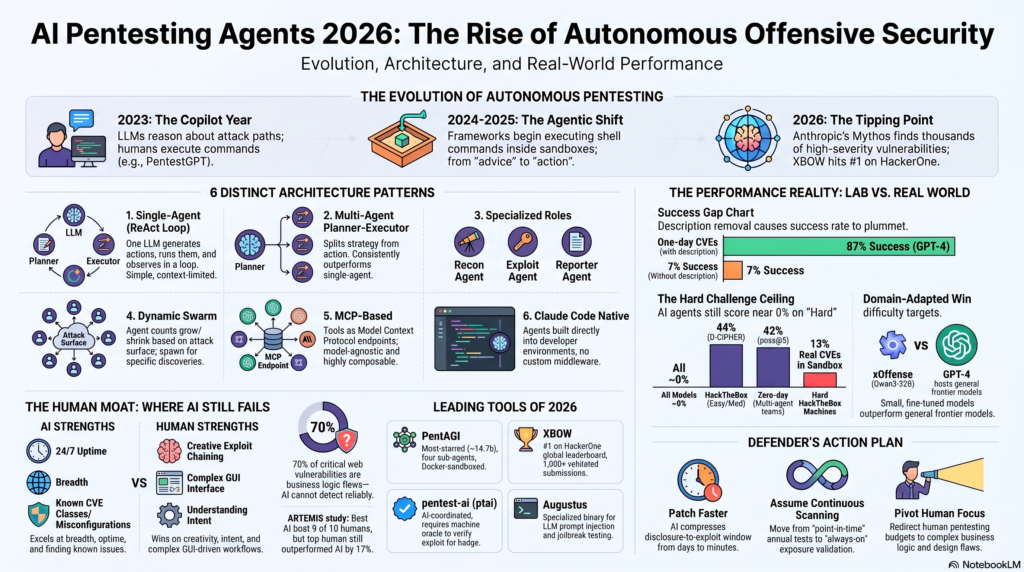
Fully autonomous AI penetration testing is the loudest claim and the weakest reality. These platforms are effectively scanners with a language model on top — and they inherit every scanner weakness.
- High false-positive rates dressed up as confident findings
- No understanding of business logic or intent
- Can’t safely judge real-world exploitability
- Miss the creative, chained attacks that matter most
A polished PDF is not proof. If no human can reproduce the finding, it isn’t a finding.
7. AI on the Attacker’s Side
The same tooling that helps defenders helps adversaries. Attackers use AI to move faster through recon, generate exploit variations, and lower the skill needed to run a campaign.
- Faster discovery of exposed and misconfigured assets
- Automated, adaptive payload generation
- Lower barrier to entry for less-skilled attackers
This is precisely why testing has to keep pace — you’re being probed by tools that don’t sleep.
Real-World Scenarios
Scenario 1: The Confident False Positive
A team runs an autonomous AI pentest platform before a product launch. The report lists a “critical” SQL injection on a checkout endpoint. Engineering scrambles for a day — only to find the payload triggered a generic error page, not a database response. The tool pattern-matched on the error text. No human ever tried to exploit it.
Scenario 2: The Chained Finding a Scanner Missed
During a manual assessment, a tester notices an IDOR on an invoice-download endpoint — low severity alone. AI-assisted recon had already flagged that invoice IDs were sequential and that session tokens didn’t rotate on logout. Chained together, any authenticated user could enumerate and download every customer’s invoices. The scanner rated each piece “medium.” The impact was critical.
Scenario 3: The Report That Wrote Itself
A tester finishes a web app engagement with 18 validated findings and rough notes. An AI assistant drafts reproduction steps, maps each issue to remediation for the client’s specific stack, and keeps severity language consistent. What used to take two days of writing takes an afternoon — and every finding was still confirmed by hand first.
Why AI-Driven Testing Cuts Both Ways
AI raises the ceiling and the floor at the same time. It makes good testers faster and bad testing more convincing.
- Speed can hide a lack of real validation
- Professional reports can mask false positives
- Broader coverage can create a false sense of completeness
- Attackers get the same acceleration you do
The tools are only as trustworthy as the human judgment behind them.
Warning Signs of a Weak AI-Powered Assessment
If you’re buying a “pentest,” watch for the tells that you’re really getting an automated scan:
- Findings with no reproduction steps you can follow
- No proof-of-concept, just a severity label
- Generic remediation copied from a knowledge base
- No named tester who can defend the findings
- A turnaround so fast no human could have validated it
- Zero business-logic or chained findings
How Organizations Can Get Real Value from AI in Testing
AI belongs in a testing program — as a force multiplier, not a replacement for skilled people.
- Use AI to accelerate recon, triage, and reporting, not to decide exploitability
- Insist that a human validates and signs off on every finding
- Ask vendors what is automated and what is manual
- Require proof-of-concept steps for each vulnerability
- Combine automated coverage with manual, attacker-driven testing
- Re-test after fixes to confirm the issue is actually closed
Best Practices for Security Teams
You can get the upside of AI without inheriting its blind spots:
- Treat AI output as a lead, never a conclusion.
- Verify every “critical” before you act on it.
- Keep a human in the loop for logic and intent.
- Prefer partners who test manually and explain their reasoning.
- Don’t confuse a longer report with a better one.
- Measure findings by reproducible impact, not raw counts.
The Future of AI in Penetration Testing
AI in penetration testing will keep improving, and the recon-to-report workflow will get faster on both sides. But the hardest part of security testing — understanding how a specific business can actually be harmed — still depends on human reasoning. The most effective programs won’t be the ones that automate testers away; they’ll be the ones that hand skilled testers sharper tools. Expect the gap to widen between assessments that use AI to think faster and “pentests” that use AI to look busy.
Final Thoughts
AI is a powerful addition to penetration testing, but it is an amplifier, not an authority. It can map an attack surface in minutes and draft a report in an afternoon — yet it cannot tell you, on its own, whether a finding is real or what it means for your business. That judgment is still the tester’s job, and it’s still where the value lives.
The right question isn’t “is this test done by AI?” It’s “who validated these findings, and can they prove it?”
In penetration testing, AI makes a good tester faster — it doesn’t make a scanner a tester.